Run a marathon using some kind of project management
Running a marathon is not just putting on the shoes, training for a while, signing up for the event and running it.
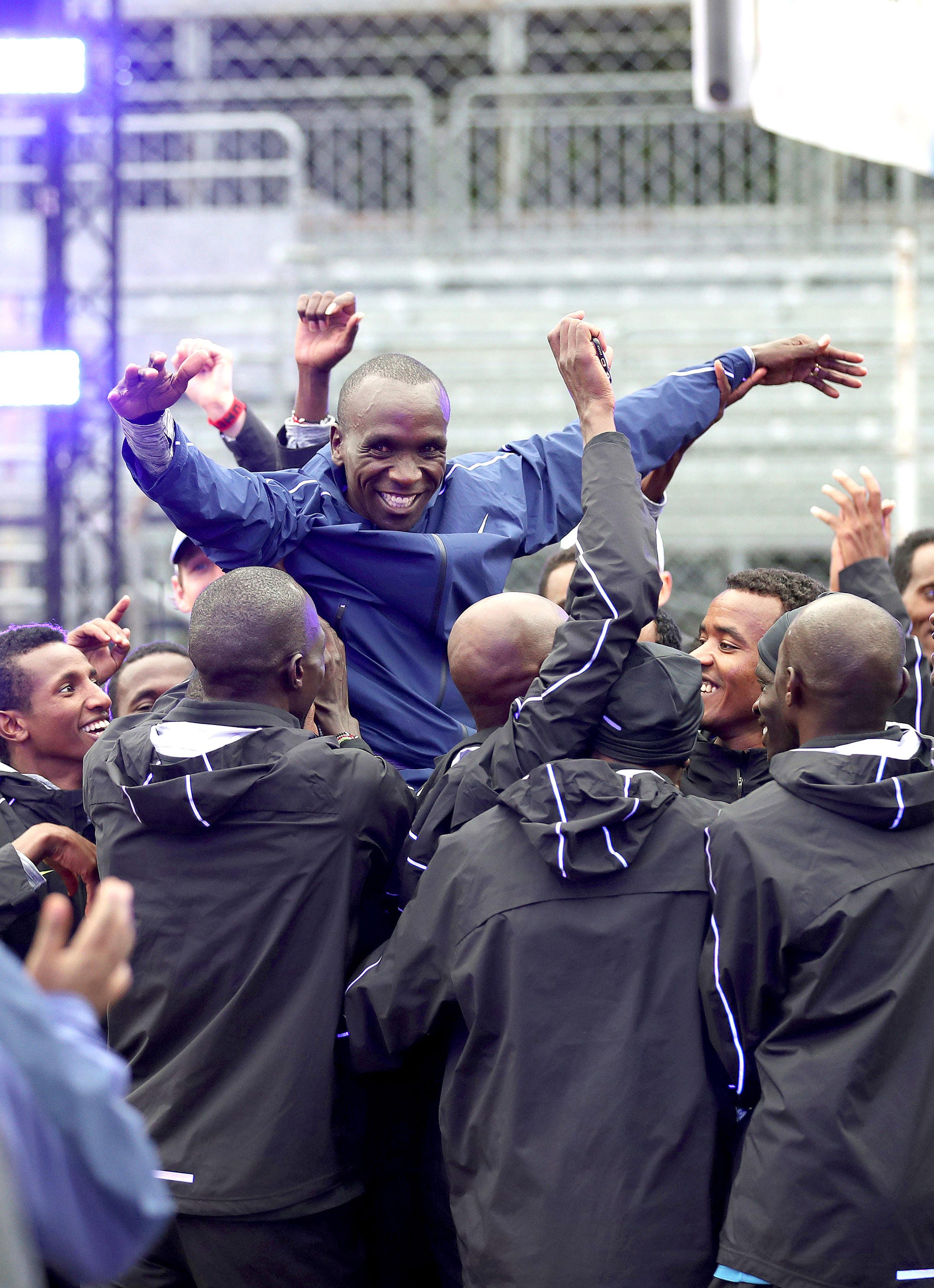
Running a marathon is not just putting on the shoes, training for a while, signing up for the event and running it.
It requires a series of actions aimed to achieve this and this require a lot of work, dedication and effort (except for strange exceptions or certain psychotropic aids).
Someone who does not run maybe does not understand the implications of what it means to run a marathon for a runner’s life, so it’s good to try to explain it.
The key ingredients to run a marathon
If we go for our first marathon, this fact will involve radically change in our way of being (more than anything if we come from a sedentary world) as it is necessary to adapt to the physical and mental changes required by the adventure of running 26 miles.
According to some studies (at least in the USA) only about 0.5% of the population participates in this type of sporting events. Although it sounds arrogant, the marathon is not for everyone.
This “sports life model" needed to run a marathon requires a list of 5 basic ingredients:
- Motivation and desire (fundamental).
- Maintain and develop minimum physical conditions to take up the challenge (health and healthy diet).
- Planning and conducting trainings with some type of sports supervision. Time.
- Economic resources to develop the activity (money).
Seeing it this way, it's looks relatively easy, but wanting to do it right, is something else.
For some runners will be easier to run a marathon than others. And in this world we are far from being all equal, it is necessary to establish the types of runners that participate in a marathon.
Types of runners in a marathon
Runners are classified according to the personal goals they pursue.
The list is made up of 6 groups:
Runners seek, try or they resign themselves to belonging to any of these groups during their lifetime as runners.
Running is something that as discussed in a previous opportunity, can have many implications in our behavior and in the way we see life.
The life of the amateur runner (someone who doesnt live to win marathons) doesnt spin 100% about run, like the approach that a professional runner can give to it, but in his day to day the amateur runner (you or me) always makes time for his workouts and more when he has a marathon in sight.
For every goal that a runner has, whatever it is, the most logical thing is that there is behind-the-scenes planning that allows you to materialize it.
Starting from this point of view it is feasible that the best way to reach a goal is giving the marathon the approach like a project.
Marathons like projects
Each marathon that a runner decides to run, is a period of time that he has to get out of his life routine to use it in order to be able to plan, control and allocate resources (time, effort and money) in order to execute many workouts (and complementary tasks) in order to achieve that desired goal.
The last paragraph largely masks the definition of a project.
When we decide to run a marathon, this simple fact makes this desire automatically to become a project (if we realize it or not) which is merged in our life routine in a somewhat overlapping manner.
Marathon project phases
The beginning of a project happens when we pass the credit card and we check the mailbox to find the marathon registration email.
It doesn't matter if it’s going to be your first marathon or number 100, the excitement of signing up and starting to train is something that moves the foundation to anyone who prizes to be a runner or who is in the process of being a runner.
Once you are already focused on what the marathon involves and what goal you have in mind (the time variable is something that takes away any runner’s sleep), it must be clear that a long journey of several months in the quest to achieve that goal.
Planning a marathon is something like this:
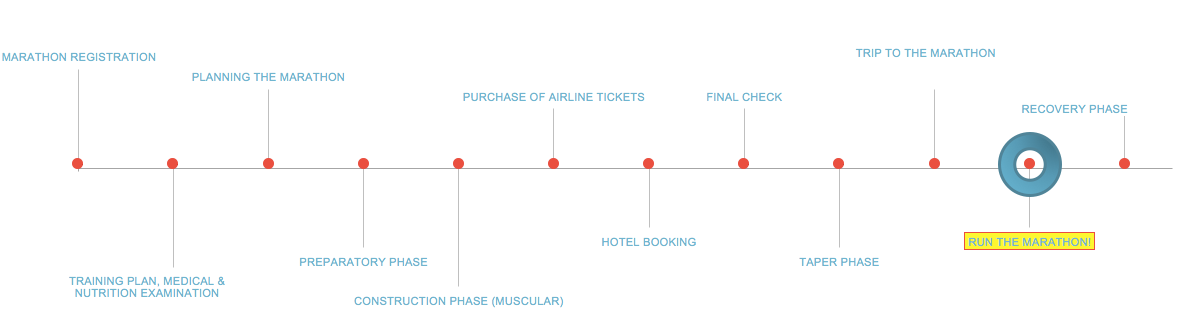
Seeing that timeline of what could be a primitive planning of a marathon project, we see that this thing isn't trivial and it’s requires some logistics and handling of many variables that can confabulate against the runner if he ignores them in any period of time during the “project life cycle”.
The plan may be more rudimentary or more complicated than they showed in the image, this try to seek give a simple idea of some phases and aspects involved to take into account that participates in this kind of project.
Obviously it is not the same thing to run a marathon in the city where you live than go to run the Tokyo marathon. More differences existed between planning if you are a professional runner or not.
A marathon is a milestone in our “life timeline” and as such thing, we must know how to manage it according to good planning, managing well all the resources involved and especially the implicit risks that we must face and know how to identify in this type of “projects”.
If we do things right, we must be clear that running a marathon has many associated risks and that all is not rosy, so be careful and plan well at all times.
If we dont properly assume and respond to risks in a timely, proactive and efficient way, we will inevitably fail in our project management and we will fail in the marathon too.* It’s some kind of law.*
Here there is little room for divine luck and miracles.
It’s always good to remember that the risks associated with this type of “projects” are nothing more than the excuses we could give in case we go wrong.
Excuses that we’ll make if we were not able to adequately handle the adverse events that caused our poor performance.
Perhaps many runners are unaware of the meaning of Project Management and Risk management, but without a doubt, many people do it to a greater or lesser extent (without realizing it) day by day since the day that they registered and decided to run a marathon.
Like all the projects can be managed well or badly, it all depends on the degree of expertise of the “PMR (Project manager Runner)” in dealing with all variables associated with the project correctly during its life cycle.
5 tips to be a good marathon project manager:
- Plan each session training properly and supervised by someone who has more experience than us. It is vital to respect the phases of training and to comply with them at all times.
- Periodic medical evaluations that allow us to diagnose the health during the workouts and the day of the marathon. This will allow us to prevent and correct possible injuries, which, if they do occur, will need to be replan and make new goals.
- You have to plan all activities complementary to the marathon (travel, stay-hotel, arrival times, departure, clothing, food, drinks, etc.) in advance and with a good time slack for each milestone associated with this phase of the project. Take this point more seriously if the marathon is in another country, especially if the climatic factors differ from those we are accustomed (clothing, acclimatization, food, etc.).
- Periodical monitoring of our progress is vital. What is not measured is not controlled. This will allow us to accurate estimates when it comes to looking for a certain time and pace on the day of the marathon. It is not advisable to be very ambitious if the conditions during the training were not the most optimal (this will avoid subsequent frustrations).
- Any possible excuse is a risk to be taken into account. When we listen to an excuse, keep it in mind that it is likely to happen to us and we musta have a plan of action in order to avoid it or to handle it properly in case it is revealed to us.
There are hundreds of tips that could be derived from all this, the important thing here is that we must always learn from our mistakes (lessons learned for the future) and we have to plan things well if we want to run a marathon.
The logical thing is that as we run more marathons we should learn to run better and in case of mistakes we have to know how to do and improve with those experiences. All this sounds logical and timely, but many times it is not or we tend to sobreestimates them.
By nature in this type of projects very few people will learn following advice from third parties, the advice is always welcome, but the experience will be in charge of making the learning little by little.
A runner who succeed in a marathon and met his expectations, is an excellent project manager.
It depends of us on whether the learning will be fast and effective or repetitive and tortuous.
Newsletter
Para el profesional tech que no quiere quedar obsoleto.
Cada semana: una dosis de criterio sobre SAP, IA de frontera y rendimiento humano. Sin motivación barata.